
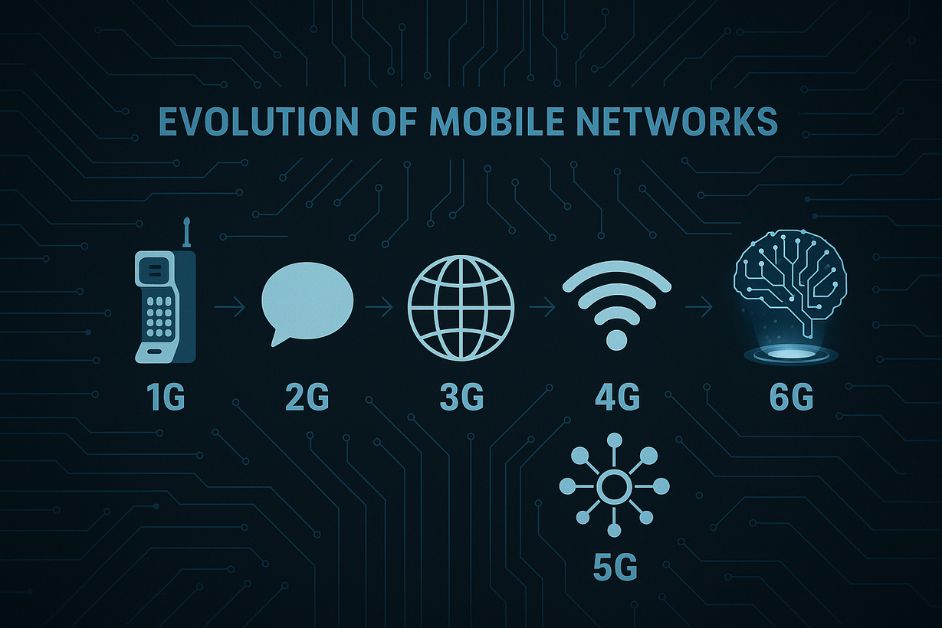
In a world where connectivity has become as essential as electricity, the journey of mobile networks from their humble beginnings to today’s lightning-fast 5G technology represents one of humanity’s most impressive technological evolutions. As we navigate through our daily lives with smartphones in hand, few of us pause to consider the remarkable infrastructure that enables our digital experiences. Today, I’ll take you through the fascinating journey of mobile network evolution—from the analog days of 1G to the revolutionary capabilities of 5G and what lies beyond.
The transformation of mobile networks over the past four decades has fundamentally altered how we communicate, work, and live. What began as simple voice calls has evolved into a complex ecosystem that powers everything from video streaming to autonomous vehicles and smart cities. This evolution represents not just technical advancement but a complete paradigm shift in human connectivity.
Key Takeaways
- Generational Leaps: Each mobile network generation (1G through 5G) has represented a fundamental shift in technology, with approximately 10-year intervals between them.
- Speed Revolution: Network speeds have increased exponentially—from 2.4 Kbps in 1G to potential peaks of 10 Gbps in 5G, representing a 4-million-fold improvement.
- Beyond Communication: Modern networks have evolved from simple voice transmission systems to complex platforms enabling IoT, autonomous vehicles, smart cities, and immersive experiences.
- Future Forward: 6G development is already underway, promising terabit speeds, 3D connectivity, and integration with AI that will further transform our digital experiences by the 2030s.
- Societal Impact: Each network generation has progressively democratized information access, with 5G and beyond poised to close digital divides and enable previously impossible applications in healthcare, education, and industry.
The Mobile Generation Timeline: Understanding the Big Picture
Before diving into the details, let’s establish a timeline that puts this technological evolution into perspective:
| Generation | Introduction | Primary Focus | Key Technology | Maximum Speed |
| 1G | 1980s | Voice calls | Analog | 2.4 Kbps |
| 2G | Early 1990s | Digital voice + SMS | GSM, CDMA | 64 Kbps |
| 3G | Early 2000s | Mobile internet | UMTS, WCDMA | 2 Mbps |
| 4G | 2010s | High-speed mobile internet | LTE, WiMAX | 100 Mbps |
| 5G | 2020s | Ultra-high speed, IoT | Millimeter waves, massive MIMO | 10 Gbps |
| 6G | ~2030 (projected) | Integrated intelligent networks | THz frequencies, AI integration | 1 Tbps (projected) |
Each generation has built upon its predecessor, solving limitations while introducing new capabilities that were previously unimaginable. Now, let’s explore each generation in detail.

1G: The Dawn of Mobile Communication
The Analog Beginning
The 1980s marked the birth of the first mobile network generation, aptly named 1G. This was the era of brick phones and analog signals—a revolutionary yet primitive start to what would become a global communications revolution.
In 1979, Nippon Telegraph and Telephone (NTT) deployed the world’s first cellular network in Tokyo, Japan. By 1983, the United States launched the Advanced Mobile Phone System (AMPS), bringing cellular technology to American consumers.
Technical Characteristics of 1G
1G networks operated on analog technology using Frequency Division Multiple Access (FDMA). They transmitted at 800-900 MHz frequencies and offered maximum speeds of around 2.4 Kbps—painfully slow by today’s standards.
The most notable aspects of 1G included:
- Analog voice only – No data capabilities
- Poor voice quality with frequent dropouts
- Minimal security – Calls could be easily intercepted
- Limited capacity – Few concurrent users per cell
- Large, power-hungry devices – The iconic “brick phones”
Limitations That Drove Innovation
While groundbreaking for its time, 1G suffered from significant limitations:
“The first generation of mobile phones was about making calls—and that’s it. It sounds simple now, but it was a massive innovation at the time.” – Martin Cooper, inventor of the first mobile phone
The inefficient use of the frequency spectrum, poor voice quality, and complete lack of security (anyone with a radio scanner could eavesdrop on calls) created clear problems that needed solving. These limitations set the stage for the next generation of mobile technology.
2G: The Digital Revolution
Going Digital
By the early 1990s, the second generation of mobile networks emerged, bringing with it a fundamental shift from analog to digital technology. This wasn’t just an incremental improvement—it was a complete reimagining of how mobile networks should function.
The European-developed Global System for Mobile Communications (GSM) became the dominant 2G standard worldwide, though the United States also developed a competing standard called Code Division Multiple Access (CDMA).
Key Innovations of 2G
2G brought several game-changing innovations:
- Digital voice encoding – Dramatically improved call quality and security
- Short Message Service (SMS) – Text messaging became possible
- Circuit-switched data – Basic data services at 9.6-14.4 Kbps
- Enhanced capacity – More users per frequency band
- Improved battery life – Smaller, more efficient phones
Perhaps the most culturally significant innovation was SMS—a feature originally designed as a technical afterthought that went on to change communication patterns worldwide.
2.5G and 2.75G: Bridging Technologies
As internet demand grew, interim standards emerged:
- GPRS (2.5G) – General Packet Radio Service added packet-switching protocols, enabling data rates up to 50 Kbps
- EDGE (2.75G) – Enhanced Data rates for GSM Evolution pushed speeds to 135 Kbps
These intermediate standards highlighted an important aspect of mobile network evolution: the need for backward compatibility and transitional technologies to bridge generational gaps.

3G: The Mobile Internet Era
The Data Revolution Begins
The early 2000s saw the introduction of 3G networks, with Japan’s NTT DoCoMo launching the first commercial 3G network in 2001. The primary goal was clear: bring the internet to mobile devices.
3G was defined by the International Telecommunication Union (ITU) under the IMT-2000 specification, requiring networks to provide peak data rates of at least 200 Kbps—though most 3G implementations far exceeded this minimum.
Technical Advancements of 3G
The third generation introduced several important technical innovations:
- UMTS (Universal Mobile Telecommunications System) – The primary 3G standard in Europe
- WCDMA (Wideband Code Division Multiple Access) – The air interface used by UMTS
- HSPA (High-Speed Packet Access) – Later upgrades (3.5G) that significantly boosted data rates
- Video calling capabilities – Though adoption was limited
- Global roaming – More standardized approach enabled better international use
The Smartphone Catalyst
While 3G launched in 2001, its true potential wasn’t realized until 2007 with the introduction of the iPhone, followed by Android devices. These smartphones created unprecedented demand for mobile data:
- Mobile web browsing became practical
- App ecosystems emerged
- Video streaming began (though often buffering)
- Social media became accessible anywhere
- Location-based services gained traction
3G networks strained under this explosive growth in data consumption, highlighting the need for yet another generational leap.
4G/LTE: The High-Speed Data Era
True Mobile Broadband
The 2010s welcomed 4G, with the first commercial LTE network launched by TeliaSonera in Stockholm and Oslo in 2009. Unlike previous generations that were primarily evolutionary, 4G represented a revolutionary approach—it was an all-IP (Internet Protocol) based network.
Key Features of 4G
4G introduced several transformative capabilities:
- LTE (Long Term Evolution) – The dominant 4G standard worldwide
- All-IP packet-switched network – Voice became just another data application
- OFDMA (Orthogonal Frequency-Division Multiple Access) – More efficient use of spectrum
- MIMO (Multiple Input Multiple Output) – Using multiple antennas to improve performance
- Theoretical speeds up to 100 Mbps when moving, and 1 Gbps when stationary
- Lower latency (around 50ms) – Critical for real-time applications
The Application Explosion
4G’s high speed and low latency enabled applications that were previously impractical on mobile devices:
- HD video streaming became smooth and buffer-free
- Video conferencing became reliable on mobile
- Cloud computing applications could run effectively
- Mobile gaming evolved beyond simple puzzles
- Rich social media with video and live streaming
- Mobile payment systems gained widespread adoption
4G LTE-Advanced
As with previous generations, 4G evolved during its lifecycle. LTE-Advanced introduced:
- Carrier aggregation – Using multiple frequency bands simultaneously
- Enhanced MIMO – More antennas for better performance
- Speeds up to 300 Mbps in real-world conditions
4G represented the point where mobile networks truly became broadband, forever changing our relationship with the internet and establishing the smartphone as the primary computing device for many people.

5G: The Connected Intelligence Era
Beyond Smartphones
The fifth generation of mobile networks began commercial deployment in 2019, with South Korea often credited as the first country to launch a nationwide 5G network. Unlike previous generations that focused primarily on connecting people, 5G was designed from the ground up to connect everything.
The Three Pillars of 5G
5G was designed around three main use cases:
- Enhanced Mobile Broadband (eMBB) – Faster speeds for consumers (up to 10 Gbps)
- Ultra-Reliable Low Latency Communications (URLLC) – Sub-1ms latency for critical applications
- Massive Machine Type Communications (mMTC) – Supporting up to 1 million devices per square kilometer
Revolutionary Technical Aspects
5G incorporates several groundbreaking technologies:
- Millimeter wave (mmWave) spectrum – Using previously unused high-frequency bands
- Massive MIMO – Arrays of multiple antennas (potentially hundreds)
- Beamforming – Focusing signal energy directly toward devices
- Network slicing – Creating virtual networks for specific applications
- Edge computing – Processing data closer to where it’s needed
- Software-defined networking – More flexible and programmable network architecture
Real-World Applications of 5G
The capabilities of 5G enable applications that were previously impossible:
- Autonomous vehicles with real-time communication
- Smart cities with thousands of connected sensors
- Industrial IoT and Industry 4.0 automation
- Extended reality (XR) including AR and VR on mobile devices
- Remote surgery and advanced telemedicine
- 8K video streaming and holographic communications
5G Deployment Challenges
Despite its promise, 5G faces significant deployment challenges:
- Infrastructure costs – Requiring many more cell sites
- mmWave limitations – Poor penetration through buildings and limited range
- Spectrum availability – Securing sufficient bandwidth
- Security concerns – More connected devices mean more potential vulnerabilities
- Misinformation – Public misconceptions about health effects
“5G isn’t just about speed. It’s about enabling a massive number of connections with the reliability needed for critical applications. It’s the first mobile network designed for machines as much as for people.” – Qualcomm CEO Cristiano Amon
Beyond 5G: The Future of Mobile Networks

6G on the Horizon
Even as 5G deployment continues worldwide, research into 6G has already begun. Countries like China, South Korea, Japan, and Finland have announced 6G research initiatives, with commercial deployment expected around 2030.
Anticipated Features of 6G
While still in early research phases, 6G is expected to include:
- Terahertz (THz) frequency bands – Opening up vast new spectrum
- Theoretical speeds up to 1 Tbps (terabit per second)
- Latency reduced to microseconds rather than milliseconds
- 3D network coverage – Including undersea, ground, and aerospace
- AI-native network design – Networks that self-optimize
- Integrated sensing and communication – Networks that can “see”
- Truly immersive XR experiences – Beyond what’s possible with 5G
Potential Applications of 6G
The capabilities of 6G could enable scenarios that sound like science fiction today:
- Holographic telepresence – Realistic 3D communications
- Internet of Senses – Digital experiences engaging all human senses
- Autonomous systems with distributed intelligence
- Brain-computer interfaces with wireless connectivity
- Digital twins of physical environments with real-time updates
- Ubiquitous global connectivity – Including remote and underserved areas
The Societal Impact of Mobile Network Evolution
Democratizing Information Access
Each generation of mobile networks has progressively democratized access to information and services:
- 1G – Made voice communication mobile
- 2G – Made text communication ubiquitous
- 3G – Brought the internet to mobile devices
- 4G – Made high-quality video and apps accessible anywhere
- 5G – Connects everything and enables new forms of work and entertainment
- 6G – May blend the physical and digital worlds in unprecedented ways
Closing Digital Divides
Advanced mobile networks have the potential to close persistent digital divides:
- Geographic divides – Fixed infrastructure is expensive in remote areas
- Economic divides – Mobile internet can be more affordable than fixed broadband
- Accessibility divides – New interfaces may make technology more accessible
Environmental Considerations
The environmental impact of mobile networks is complex:
- Energy consumption increases with each generation
- Equipment lifecycle and e-waste concerns
- Enabling technologies that can reduce other forms of environmental impact
- Smart grid optimization and resource management
Preparing for the Future: What Organizations and Individuals Should Know
Business Implications
For businesses, each network generation brings both opportunities and challenges:
- New business models become possible
- Customer expectations change
- Infrastructure investments are required
- Security approaches must evolve
- Competitive landscapes transform
Individual Preparation
For individuals, preparing for future networks involves:
- Digital literacy – Understanding the capabilities and limitations
- Privacy awareness – As more devices connect, privacy concerns increase
- Skills development – New technologies require new skills
- Responsible consumption – Understanding the environmental impact
- Critical thinking – Evaluating claims about new technologies
Conclusion: The Continuous Evolution of Connectivity
The journey from 1G to 5G and beyond represents one of the most rapid and transformative technological evolutions in human history. In just four decades, we’ve gone from simple voice calls on bulky devices to the brink of immersive, intelligent networks that will connect nearly everything around us.
This evolution shows no signs of slowing down. As 5G deployment continues worldwide and 6G research accelerates, we can expect the boundaries between physical and digital to blur even further. The networks of tomorrow won’t just connect us—they’ll understand us, anticipate our needs, and create new possibilities we haven’t yet imagined.
As we look toward this connected future, the most important thing to remember is that these networks aren’t just technical achievements—they’re tools that can solve human problems, create new opportunities, and potentially address some of our most pressing challenges. The true measure of their success will be not just in speed or capacity, but in how they improve lives and create a more equitable, sustainable world.
I encourage you to stay informed about these evolving technologies, consider how they might impact your life and work, and participate in discussions about how we can shape them to best serve humanity’s needs.
Call to Action
Are you ready for the next generation of mobile connectivity? Here’s what you can do now:
- Stay informed about 5G deployment in your area
- Consider 5G capabilities when purchasing new devices
- Explore potential applications for your business or personal use
- Participate in discussions about spectrum policy and digital equity
- Share your thoughts on how these technologies should develop
What aspects of future mobile networks are you most excited about? Share your thoughts and join the conversation about how we can shape this technology for the greatest benefit!