Web App · 2026 · Asghar Enterprises
Asghar Enterprises — Coal Trading Accounts
CompletedDouble-entry accounting and coal stock for a coal trading business
Problem
A coal trader buying from mines and selling to customers by the truckload needed proper books — and needed to know, at any moment, how many tons of each coal type were in stock and what a trade actually earned.
Solution
An accounting system built by adapting Chicken Master's accounts module to the coal trade: purchase and sale vouchers recorded per truck with tons, rate, and vehicle number, coal stock tracked in tons with a drill-down ledger, and a trading P&L valued against opening and closing stock.
Outcome
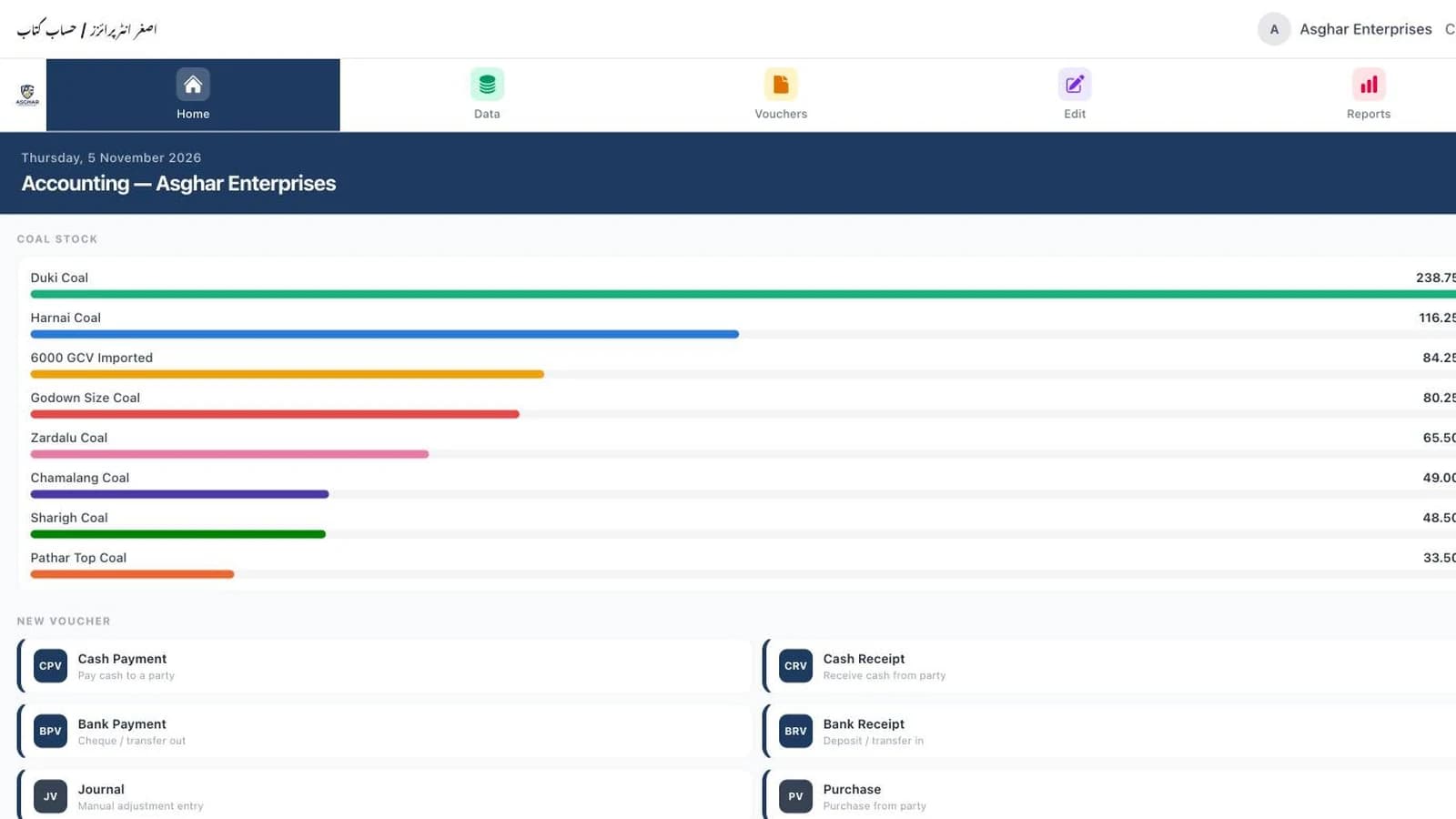
- Coal stock per type, in tons, is on the home screen instead of in a notebook
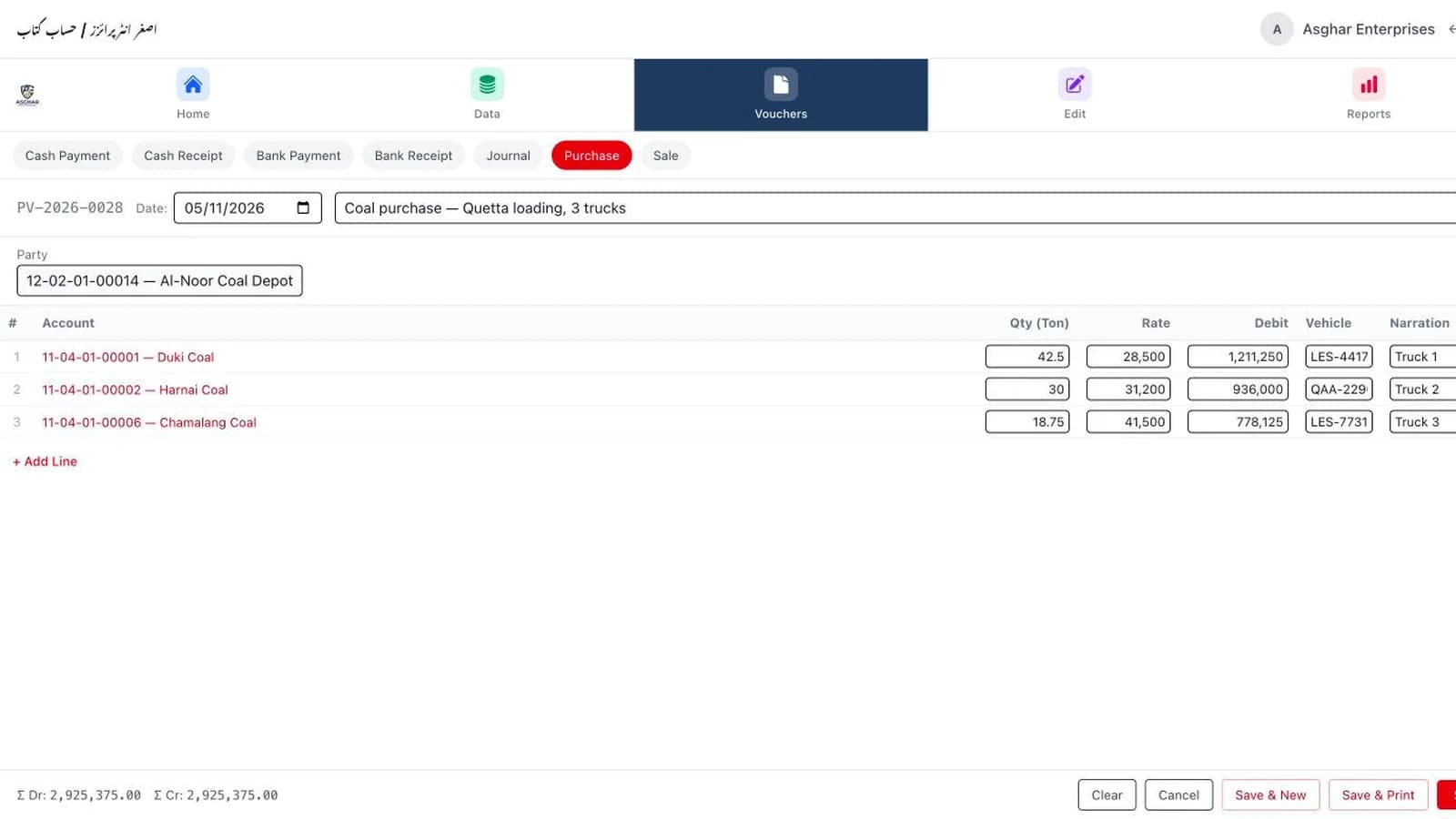
- Every purchase and sale is recorded per truck with its vehicle number, so a load can be traced end to end
- Built in weeks by reusing a proven accounting core, with shared fixes flowing to every business that runs on it
Background
Asghar Enterprises trades coal: it buys from mines and suppliers and sells to customers, one truckload at a time. The money side needed real double-entry books, and the trade side needed something the books alone don't give — how many tons of each coal type are on hand, and what each trade earned against what it cost.
One accounting core, many businesses
I'd already built a full accounting module inside Chicken Master: a hierarchical chart of accounts, voucher types, party ledgers, and reports. Rather than start again, Asghar Enterprises runs on that same codebase as its own white-label instance — its own branch, its own database, its own branding — so a fix to the shared accounting core is merged forward to every business using it instead of being re-applied by hand.
What made it an Asghar Enterprises system rather than a copy was the coal-specific work on top.
What I built for the coal trade
Stock in tons, not just rupees
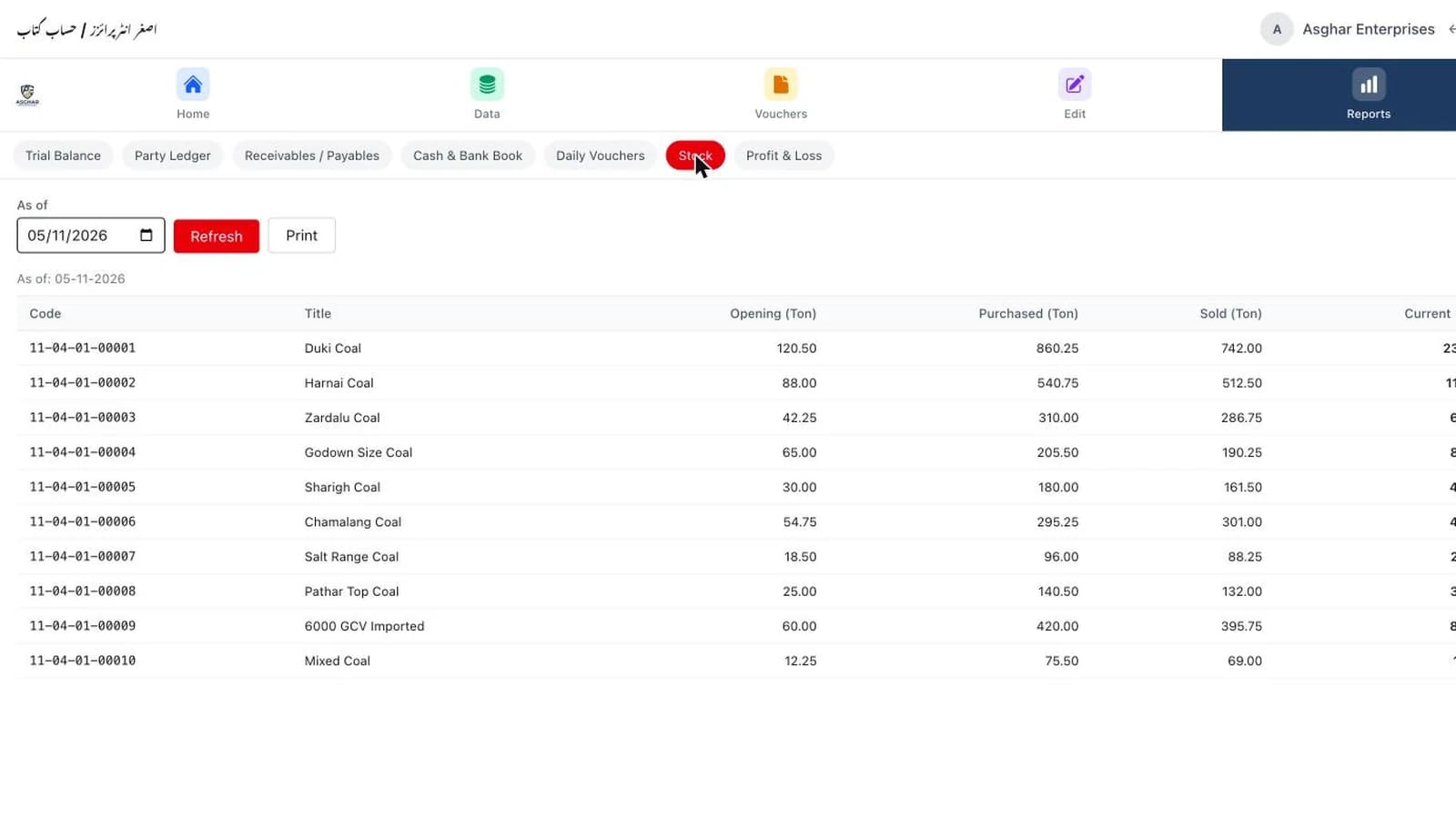
Each coal type is an account that can track quantity. Purchase voucher lines record the tons bought; sale voucher lines are tagged with the coal type sold. The Stock report shows opening, purchased, sold, and current tons for every coal type as of any date, with a ledger drill-down to the individual vouchers behind a number — and the home screen shows the whole position as a bar chart.
Vouchers that match how coal moves
Coal is bought and sold by the truck, so purchase and sale vouchers carry a line per load: coal type, quantity in tons, rate, and the vehicle number. Quantity times rate fills the amount, and the vehicle number follows the load into the party ledger, so a disputed delivery can be traced. The party picker only offers debtor and creditor accounts, and which groups count is configurable in settings.
A trading P&L
The Profit & Loss report starts with a proper trading account: opening stock and closing stock valued per coal type, purchases, and sales, giving gross profit before operating expenses.
Built for the people using it
The header carries the business's name in Urdu, managers can be given read-only access, every report prints across multiple pages with a branded header, and changing a password ends every open session for that user.
The screenshots on this page use made-up sample data — the client's real figures stay private.
Stack notes
React, Vite, TypeScript, and Tailwind on the front end; Node.js and Express for the API; Supabase for Postgres, auth, and storage. Report queries page past Supabase's 1,000-row limit so large ledgers are never silently cut short.
Screenshots
Running a similar operation?
I build systems like this end to end — from the data model to the day-to-day screens your staff actually use.
Get in touch